The short answer
No. Original Medicare (Parts A and B) does not pay for pill organizers or automatic pill dispensers. The exception worth knowing: Part D plans must offer a free Medication Therapy Management review to members with several chronic conditions and drugs costing $1,276 or more a year in 2026. Some Medicaid waivers cover dispensers.
This guide is for people on Medicare who juggle several prescriptions, and for the family members who worry about missed or doubled doses. The one thing to know: Medicare won't buy the gadget, but a Part D drug plan may give your parent something just as useful for free, a one-on-one medication review with a pharmacist. A Medicaid waiver or a pharmacy packaging service can sometimes cover the rest.
What Original Medicare covers vs. what it does not
"Original Medicare" means Part A (hospital) and Part B (medical). Prescription drugs are covered separately, by a Part D plan or by a Medicare Advantage plan that includes drug coverage.
| Item or service | Original Medicare (Parts A and B) | Where help may come from |
|---|---|---|
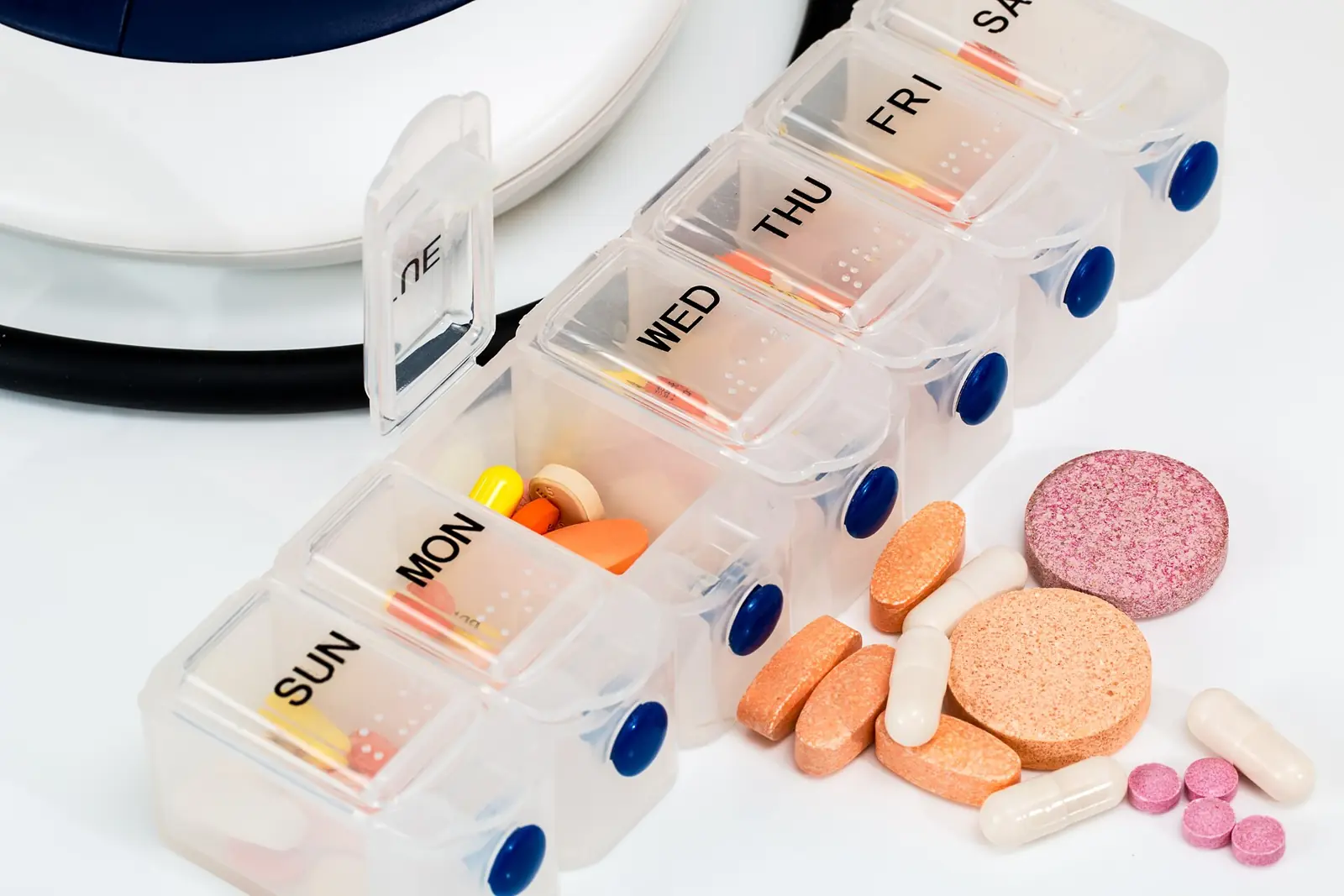
| Weekly pill organizer (plastic box) | Not covered | An Advantage plan over-the-counter allowance, if the plan's catalog lists one |
| Automatic or smart pill dispenser (such as Hero) | Not covered | Some Medicaid waiver programs; HSA or FSA funds, if the seller says the device qualifies |
| Monthly dispenser subscription | Not covered | Same as above |
| Medication Therapy Management (MTM) review with a pharmacist | Not a Part A or B benefit | Free through Part D plans for members who qualify |
| Your prescription drugs | Not covered (except certain drugs given in a doctor's office or hospital) | Part D plan or Advantage plan with drug coverage |
| Pharmacy packets sorted by dose and time | Not covered | Some pharmacies offer this with no extra charge beyond your usual copays |
Why Original Medicare says no
Part B pays for durable medical equipment (DME), such as walkers, hospital beds and blood sugar monitors. Medicare's DME page says covered equipment must be durable, used for a medical reason, typically only useful to someone who is sick or injured, used in the home, and expected to last at least three years. Pill organizers and automatic dispensers are not on Medicare's list of covered equipment, and Original Medicare does not pay for them or for a dispenser's monthly service fee.
A Medigap (Medicare Supplement) policy won't change that. Medigap pays toward your share of services Original Medicare covers, so it has nothing to add here.
Part D's Medication Therapy Management program (2026)
This is the Medicare benefit many families have never heard of. Every Part D drug plan, including Medicare Advantage plans with drug coverage, must run a Medication Therapy Management (MTM) program. If your parent qualifies, the services come "at no cost to you," according to Medicare.gov.
Who qualifies in 2026
Under the federal rule (42 CFR 423.153(d)) and CMS's 2026 MTM memo, a plan must offer MTM to members who meet all three of these:
- Several chronic conditions. A plan can require up to three. It must count conditions on a federal list of 10: Alzheimer's disease, bone disease and arthritis (including osteoporosis), chronic heart failure, diabetes, high cholesterol (dyslipidemia), end-stage kidney disease, HIV/AIDS, high blood pressure, mental health conditions (such as depression), and respiratory disease (such as asthma or COPD).
- Several Part D drugs. A plan can require up to eight, and must count all maintenance drugs.
- High drug costs. The member is likely to have yearly covered drug costs at or above the MTM cost threshold, which CMS set at $1,276 for 2026.
Members in a plan's drug management program (for people at risk of misusing opioids and certain other drugs) also qualify. Plans can set a lower bar than the maximums above, for example two conditions instead of three, so the exact rules depend on the plan.
What your parent gets
- A yearly comprehensive medication review. A pharmacist or other qualified provider goes over all of your parent's medicines and why each one is taken, in person or through a live telehealth call.
- A written summary with a medication list and a "Recommended To-Do List" to bring to the doctor.
- Reviews at least every three months, in which the plan looks over your parent's medicines and follows up when it spots a problem.
Enrollment is automatic for people who qualify: plans must use an opt-out method. If your parent has memory problems and can't take part, the rule allows the review to happen with a caregiver or other authorized person instead. That makes MTM a practical tool for adult children helping from a distance.
Tip: If your parent takes several medicines and has never been offered a medication review, call the Part D plan and ask, "Am I eligible for your Medication Therapy Management program?" Bring up any trouble remembering doses during the review. The pharmacist may suggest simpler timing, blister packs or a reminder device.
Medicare Advantage extras that may help
Medicare Advantage (Part C) plans can add benefits Original Medicare doesn't cover. Two are worth checking for medication help.
Over-the-counter (OTC) allowance. Many plans give members a set amount each month or quarter to spend on health items from a catalog. In 2026, 68% of enrollees in individual Advantage plans are in a plan with an OTC benefit, down from 79% in 2025, according to KFF. If your parent's plan has one, look in the catalog for pill organizers. CMS's Medicare Managed Care Manual says plans can't give members cash for OTC items, only a catalog, card or reimbursement for listed items, so if an item isn't in the catalog, the allowance won't cover it.
In-home support. KFF found that 10% of individual-plan enrollees (and 38% of Special Needs Plan enrollees) are in plans offering in-home support services in 2026. Ask whether the benefit includes help with medication reminders.
If the plan's documents don't mention a medication dispenser, call and ask before assuming one is covered.
Does Medicaid pay for pill dispensers?
In some states, for people in a Medicaid home and community-based services (HCBS) waiver program, yes. These waivers help people who would otherwise need nursing home care stay at home. Each state chooses which services to include and how many people to serve, according to Medicaid.gov.
Two examples:
- Indiana covers medication dispensers as a "Specialized Medical Equipment and Supplies" item under its Health and Wellness, PathWays for Aging and Traumatic Brain Injury waivers, according to a February 2025 state bulletin. The same bulletin says filling the dispenser is not a waiver service, and that pharmacy "pill packs" do not count as a medication dispenser.
- Colorado's rules list "medication reminder systems" under electronic monitoring services in its waivers (10 CCR 2505-10 8.7520).
Ask your parent's waiver case manager or the state Medicaid agency. If you don't know where to start, the Eldercare Locator (1-800-677-1116) can connect you with the local Area Agency on Aging.
Pharmacy services: blister packs and refill syncing
Before buying a dispenser, ask the pharmacy what it already offers. Two services can make a big difference:
- Multi-dose packaging. The pharmacy sorts pills into packets or blister cards labeled by date and time of day. Amazon's PillPack, for example, sorts medicines "by date and time into convenient packets" for people who take two or more prescriptions, says there is no additional charge for the service, and accepts Medicare and Medicaid plans, depending on state rules for automatic refills. Many local pharmacies offer blister packs too; ask whether there is a fee.
- Medication synchronization. Often called "med sync," this lines up refills so your parent picks up everything on one day each month. It cuts down on gaps from forgotten refills.
Ask the pharmacist which option fits your parent's medicines. Some drugs can't go into blister packs, and only the pharmacist or doctor should change how or when a medicine is taken.
What a smart dispenser costs if you pay yourself (October 2026)
Automatic dispensers lock pills inside and release each dose at set times, with alarms and, on some models, alerts to a family member's phone. As one example, Hero's pricing page in October 2026 lists a 12-month prepaid plan starting at $29.99 a month, a monthly payment plan at $44.99 a month with a 12-month commitment, or a no-commitment plan at $59.99 a month. The same page also advertises "starting at $39.99/mo with prepaid plans," so confirm the price at checkout. All plans include a 30-day money-back guarantee if you return the device within 30 days of activation. The page does not spell out early cancellation fees on the commitment plans, so ask before you sign up.
Hero's insurance page says HSA and FSA funds can be used, and that a subscription "may" be covered by Medicare as part of remote therapeutic monitoring services billed by a doctor, with coinsurance possibly applying. That depends entirely on your parent's doctor offering and billing that service, so ask the doctor's office directly rather than counting on it.
If you use HSA money, remember that under IRS Publication 969, a person can't contribute to an HSA starting the first month they are enrolled in Medicare, though money already in the account can still be spent.
For a side-by-side look at dispensers, reminder apps and simpler options, see our guide to medication reminders for seniors. If memory loss is part of the picture, our memory section and guide to digital calendars for seniors may also help.
How to check your own plan
- Read the Evidence of Coverage. Search it for "Medication Therapy Management," "over-the-counter" and "in-home support." The OTC catalog usually comes as a separate booklet or web page.
- Call the plan. Ask: Does my parent qualify for MTM this year? Does the OTC catalog include pill organizers? Is any medication dispenser covered?
- Call 1-800-MEDICARE (1-800-633-4227) for help with Part D questions or comparing plans during Open Enrollment.
- Get free counseling from your local SHIP. State Health Insurance Assistance Programs offer free, unbiased Medicare help. Find yours at shiphelp.org.
Be wary of "free device from Medicare" calls. Medicare says it will never call you to sell you anything or visit you at home. Don't share your Medicare number with a caller offering free equipment. Report suspected fraud to 1-800-MEDICARE.
More answers are in our Medicare section, including whether Medicare covers blood pressure monitors.
Common questions
Does Medicare cover automatic pill dispensers?
No. Original Medicare does not pay for automatic pill dispensers, simple pill organizers or dispenser subscriptions. Some state Medicaid waiver programs cover dispensers for people who qualify.
What is Medicare's Medication Therapy Management program?
It is a free service that every Part D plan must offer to members with several chronic conditions, several Part D drugs and high drug costs. In 2026 the cost threshold is $1,276 a year. Members get a yearly medication review with a pharmacist and a written summary.
Will a Medicare Advantage plan pay for a pill dispenser?
Some plans let you use an over-the-counter allowance for pill organizers if they are in the plan's catalog. For an automatic dispenser, check the Evidence of Coverage or call the plan before buying.
Does insurance cover the Hero pill dispenser?
Original Medicare does not cover it as equipment. Hero says HSA and FSA funds can be used and that its subscription may be covered when a doctor bills Medicare for remote therapeutic monitoring, so ask the doctor's office.
Can the pharmacy sort my parent's pills for free?
Some can. Amazon's PillPack says it charges nothing extra for sorting pills into dated packets, and many local pharmacies offer blister packs or refill syncing. Ask your pharmacist about fees.
Sources
We checked these sources on October 31, 2026.
- Medicare.gov: Durable medical equipment (DME) coverage
- Medicare.gov: Medication therapy management programs for complex health needs
- CMS: Contract Year 2026 Medication Therapy Management Program Submission memo
- CMS: Medication Therapy Management
- 42 CFR 423.153, Drug utilization management and MTM (Cornell LII)
- KFF: Medicare Advantage in 2026: Premiums, Out-of-Pocket Limits, Supplemental Benefits, and Prior Authorization
- CMS: Medicare Managed Care Manual, Chapter 4, Benefits and Beneficiary Protections
- Medicaid.gov: Home and Community-Based Services 1915(c)
- Indiana Health Coverage Programs bulletin BT202527 (February 27, 2025)
- Colorado 10 CCR 2505-10 8.7520, Electronic Monitoring (Cornell LII)
- Amazon Pharmacy: PillPack
- Hero Health: Pricing
- Hero Health: Insurance and caregiver reimbursement
- IRS Publication 969: Health Savings Accounts and Other Tax-Favored Health Plans
- Medicare.gov: Reporting Medicare fraud and abuse
This guide is general information, not medical, legal or financial advice. Medicare Senior is independent and is not affiliated with Medicare or any government agency. No company paid to be mentioned here.
Coverage rules can change every year and Medicare Advantage benefits vary by plan. To confirm your own coverage, call your plan or 1-800-MEDICARE (1-800-633-4227), or get free help from your State Health Insurance Assistance Program at shiphelp.org.